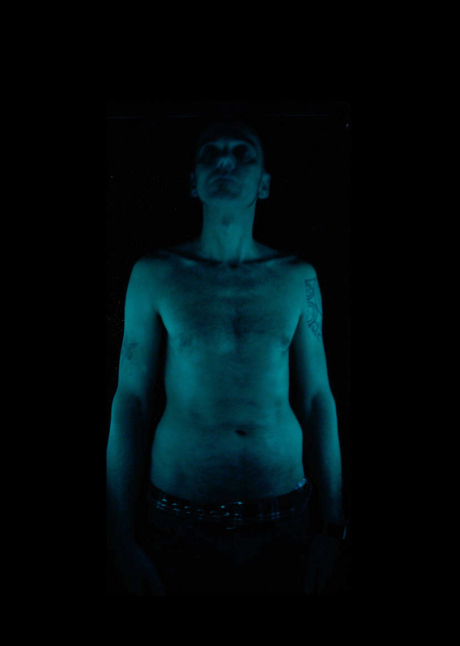
Participants filmed in the single wavelength light emissions of deep sea bioluminescent bacteria.
Installation in the Old Operating Theatre, London
The one-night installation in the Herb Garrett threads in Brodie’s work with ceramics and glass and continues to question the role of the object in life’s daily rituals. Brodie’s collection of old cups, saucers, glasses, spoons, bowls and vases bought in car-boot sales and charity shops are displayed filled with nutrient agar gel inoculated with Photobacterium phosphoreum. The bacteria have a life span of approximately thirty-six hours. In the process the array of objects glimpses back exposing the impermanency of use in daily life and beyond. Unsuited for the laboratory, they magnify the precariousness of fashion, habits, and sentimentality.

The projected photographs in the Old Operating Theatre were displayed within the original photo-booth in which the images were taken using the light emitted by living bacteria. The images restage the long exposure of the camera lens in the improbable and at times disquieting bioluminescence that gradually fades as the bacteria die. Brodie’s lens quietly captures the ineffableness of life’s formation and the fleeting reality of subjectivity.

W. G. Sebald, The Rings of Saturn

“From the earliest times, human civilization has been no more than a strange luminescence growing more intense by the hour, of which no one can say when it will begin to wane and when it will fade away.” W. G. Sebald, The Rings of Saturn
‘Bioluminescent photograph booth’
The ‘Bioluminescent photograph booth’ was installed for two days at the British Science Festival. The dark space filled with hundreds of glowing petri dishes engaged with children and adults during the day, on sat evening it went into action as 9 willing volunteers stood naked, immersed in bacterial light in order that a photographic image could be produced. A huge thank you to all of the volunteers for their intrepid spirit. Everyone reported back that they felt the experience to be extremely positive and uplifting.
We undress for medical reasons, exposure usually associated with discomfort and fear. Exposure in this case, cocooned in the faint blue light brought calm and quietness.

Bioluminescent photograph booth at Surrey Univeristy Campus during the British Science Festival
